Bike fitting is younger than most riders assume, and its foundations are narrower. The numbers that shaped it came from a handful of studies, some of them very small, and the commercial practice grew up separately from the research. This page sets out where the main reference points came from, with the sources named, because the history is more interesting than the folklore.
The first number came from a two-page abstract
The saddle-height convention most riders have encountered — roughly 109% of inside leg measurement — was published by E. J. Hamley and V. Thomas in 1967.
It is worth knowing what that publication actually was. The citation runs to pages 55P–56P of the Journal of Physiology, and the “P” marks it as a Proceedings of the Physiological Society abstract: roughly two pages, presented at a meeting. The number that went on to shape bike fitting for the next fifty years entered the literature as a conference abstract rather than as a full paper.
That is not a criticism of the work. It is context. A short abstract is a reasonable place for a first finding, and 109% has held up well enough to still be in use. It simply was never the exhaustive investigation its later reputation implies.
Ten years later, a different landmark gave a different answer
In 1977 Karen Nordeen-Snyder published a study in Medicine and Science in Sports that measured saddle height differently. Instead of working from inside leg, she measured from the greater trochanter, the bony point at the top of the thigh bone, and tested saddle heights at 95%, 100% and 105% of that trochanteric height.
Ten female cyclists rode at a steady 60 rpm at each height while oxygen consumption was measured. The means came out at 1.69, 1.61 and 1.74 litres per minute, making 100% of trochanteric height the most economical of the three. Hip range of motion did not vary meaningfully between the settings. What did change were the joint values at the top and bottom of the pedal stroke.
Why two foundational numbers never settled the question
Hamley and Thomas measured from inside leg and arrived at 109%. Nordeen-Snyder measured from the greater trochanter and arrived at 100%. These are not competing results, because they are not measuring the same distance from the same place. But taken together they show something the folklore leaves out: the field’s two foundational numbers were never one settled answer.
Both studies were small, both used a specific population, and both were looking at economy at a fixed cadence rather than comfort, sustainability or injury over a season. They are a good starting point and a poor stopping point. That is the honest position, and it explains why a fit that works only from a formula tends to produce a number that is defensible on paper and uncomfortable after three hours.
Fitting becomes something a bike shop can do
The research and the commercial practice developed separately. Bill Farrell founded the New England Cycling Academy at the end of the 1970s — a date that comes from the successor company’s own account of its history — and over the following years built the tools that turned fitting into a repeatable shop procedure.
Two of them mattered. The Rotational Adjustment Device, usually shortened to R.A.D., addressed cleat alignment. The Fit Kit, a box of measuring tools with accompanying lookup tables, addressed frame sizing. Together they meant a shop could measure a rider and produce a consistent recommendation without a specialist present. No source establishes an exact year for the Fit Kit’s creation; the early 1980s is what the evidence supports, and the system spread widely through bike shops from there.
Watching someone ride, rather than measuring them standing still
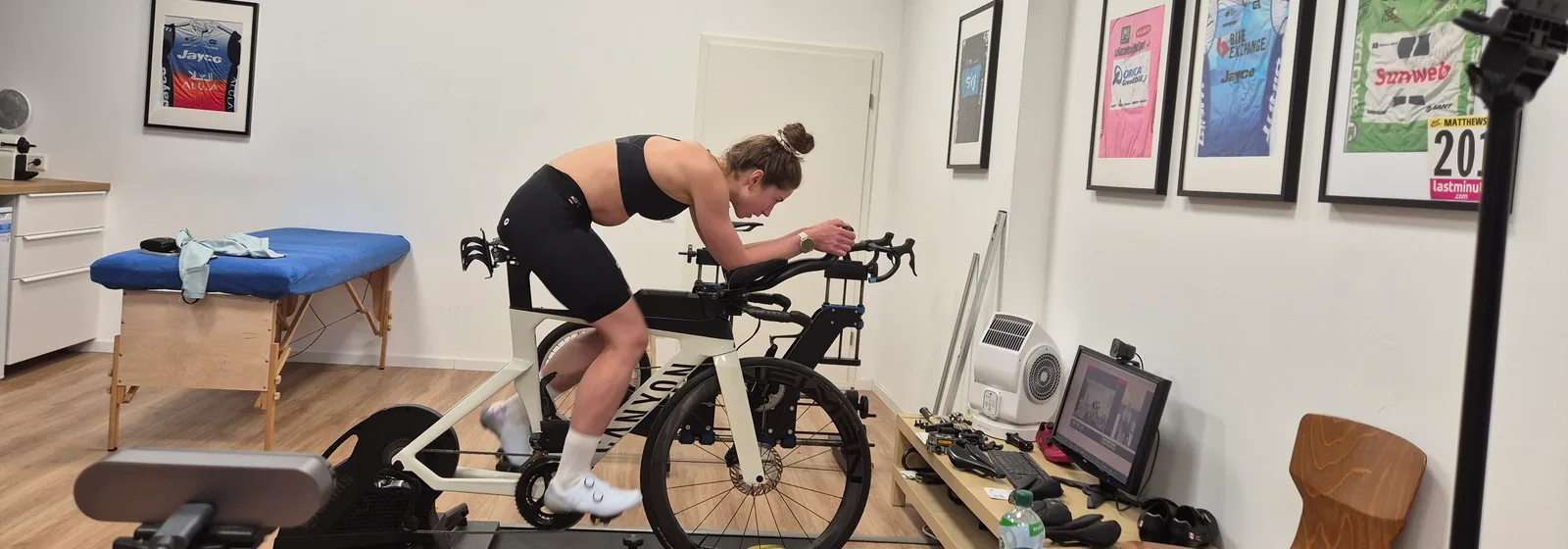
Ben Serotta, whose framebuilding company was founded in 1972, approached the problem from a different direction with the Size Cycle. It was an adjustable stationary bike with quick-release levers on every adjustable part, so a fitter could change dimensions and take measurements while the rider was actually pedalling, then order a custom frame built to those numbers.
That is a meaningful shift in method. Measuring a stationary rider tells you about their proportions; watching a moving one tells you what they do under load, which is not always the same thing. Serotta later formalised the teaching side, with a Fit School beginning in 1998 that became the Serotta International Cycling Institute.
The clinical turn
Andy Pruitt came to the same problem from sports medicine rather than from framebuilding or retail. Through his work at the Boulder Center for Sports Medicine, he treated cycling complaints as clinical presentations with mechanical causes, which put the rider’s history, injuries and anatomy alongside the bike’s measurements.
His 2006 book with Fred Matheny, Andy Pruitt’s Complete Medical Guide for Cyclists, published by VeloPress, set out cycling injuries and their fit-related causes together in one place. That pairing — the symptom and the setup that produces it — is the framework most problem-solving fitting still uses.
What the history actually tells you
Three things, and they are all useful before you book anything.
The numbers are real but partial. They came from small studies asking narrow questions, and they remain good starting points precisely because nobody has replaced them with something better and broader. Second, the practice grew from several directions at once — physiology, retail, framebuilding, sports medicine — which is why fitters can differ so much in what they emphasise. Third, the move that has mattered most across sixty years is the shift from measuring a stationary body to observing a moving one under load.
That is how I work in Bensheim: from what your body does on the bike, with the reference numbers as context rather than as the answer.
Sources
-
Hamley EJ, Thomas V. Physiological and postural factors in the calibration of the bicycle ergometer. Journal of Physiology. 1967;191(2):55P–56P.
-
Nordeen-Snyder KS. The effect of bicycle seat height variation upon oxygen consumption and lower limb kinematics. Medicine and Science in Sports. 1977;9(2):113–117.
-
Fit Kit Systems, company history (the company’s own account of its origins).
-
Bicycle Retailer and Industry News, 2022, on Bill Farrell and the Fit Kit.
-
Pruitt AL, Matheny F. Andy Pruitt’s Complete Medical Guide for Cyclists. Boulder, CO: VeloPress, 2006. LCCN 2005031464.